The Escondite

The Dr. Joyce Brothers
The Fat Albert
The Fat Albert

If you’re willing to take a spin to the kinda sketchy border of Little Tokyo and Skid Row, you’ll discover a few things: first, the dark side of gentrification; second, ample free street parking (the meters die at 6 pm!); and third, one of the weirdest dives I’ve yet been to in this town: The Escondite (which, aptly, is Spanish for “hideout”).

The first thing you notice when you walk into The Escondite is that it’s an eclectic spot. Deer antler chandeliers (fully outfitted with cheesy, fake-flickering, bright-orange electric candles) hang over the length of the bar. The back wall is wood-paneled and lined with vintage western posters, kind of evoking Bigfoot West in West L.A. Just near the entrance is a cramped stage tailor-made for a (probably pretty shitty) 80s cover band.

The next thing you’ll notice is that it’s decidedly a Chicago bar. The city flag hangs over the far end of the bar, and there are more Blackhawks banners and commemorations than you can shake a stick at (which – at least for someone with a distaste for the most boring iteration of evil – were pretty difficult to stomach). One almost expects to see a Rahm Emanuel staffer drafting menacing text messages, or a couple fat dudes getting drunk and loudly promising everyone that this year would be the Bears’ year, or a couple of hopelessly unwashed bros trying to hit on the bartender by yelling “GO CUBS” and offering limp-wristed high fives. Okay, so I actually saw all but one of those things.

But I digress.

I met up with Sergio to try a couple of their many (deeply insane) burgers. I walked in around 5:30. The place was still glowing from the Blackhawks tragic victory this Monday last. I muttered a few words that I won’t republish here (this is a family blog, after all), I slid into a booth, and I put my back to the wall. Facing the bar, staring ahead, I saw not one, but two Blackhawks banners hanging behind the row of taps. I muttered a tasteful variation of the same epithet I mentioned above. All I could think about was how Duncan Keith couldn’t seriously have won the Conn Smythe Trophy. All that team spirit…for such a horrible, soulless team? And this affront in the shadow of Staples Center? It was almost enough to make me lose my appetite. Almost.

But, I reminded myself, I wasn’t there to get sad about the fearsome, seemingly unstoppable expansion of hockey’s evil empire (help me, Tanner Pearson…you’re my only hope). I was there to eat a burger. So I put those deflating thoughts out of my head. Sergio and I each ordered one, and split them right down the middle.

The Place
The Escondite
410 Boyd Street
Los Angeles, CA 90013

The Order: One Dr. Joyce Brothers, one Fat Albert, Coke (for me), Diet Coke (for Sergio). Note: The Escondite does not allow substitutions.

The Price: $32.16, all told.

The Burger(s!)
Part One: The Dr. Joyce Brothers
The first burger was our server’s favorite. She self-identified as being into the “plainest stuff in the world.” The Dr. Joyce Brothers, she assured us, is the most accessible burger on the menu. A six-ounce patty with melted provolone cheese was rounded out with a lone (but substantial) tomato disc, a thicket of sprouts, wide slices of avocado, red onion, romaine lettuce, and a drizzle of Italian dressing on a buttery brioche bun.

To be fair, this one was as advertised: It was essentially the plainest thing ever. From beef to bun, nothing really stood out and took charge of the flavor profile. There were a variety of textures in play: crisp romaine, rich avocado, the wild tangle of the sprouts. This textural diversity was the only thing I could really grab onto with this burger. None of the toppings imparted any flavor. At all. For all its heft, the burger didn’t really pack a punch. The only thing that had much flavor at all was the Italian dressing, which was comprehensively lost beneath the din of bland, wiry sprouts and blunted by the avocado.

Speaking of which, I never thought there was any such thing as “too much” avocado. But this burger might just have had too much avocado. And that’s not necessarily because of the avocado itself (far be it from me to blame avocado for anything – I’m not a heretic). It’s just that avocado is not much of a flavor centerpiece. It’s the perfect – perfect – complement. It adds a neutral textural matrix in which other flavors interact beautifully (think guacamole). It neutralizes harsh flavors well, allowing for more daring contrasts (like, say, my renowned grapefruit-habañero guacamole). Here though, it was left to pull all the weight, flavor-wise, and that’s just not what avocado is meant to do.

Our server recommended that we have the patty cooked medium. This was a true medium – very little pink, and you could really taste the grill. Sadly, it wasn’t much of a patty. It was six ounces of what tasted like regular old chuck – it was too insipid to be Angus, too dry to be brisket, not tender enough to be sirloin. While six ounces may not seem like much, it’s pretty noticeable when it’s not providing much in the way of flavor.

Oddly, the bun was the most interesting part of the burger. A complex brioche-esque thing, it had a sweet, front end that gave way nicely into a buttery finish. Light but not absorbent, it was pretty delicious. But otherwise, this burger was as bland and soulless as the 2015 Stanley Cup Champion Chicago Blackhawks: good on paper, but they ain’t got no heart. Suck it, Jonathan Toews.

Part Two: Fat Albert
This is where the action was. When I first had the idea for the burger project, it was stuff like this that I was excited to eat. Burgers that were devilishly weird, adventurous, brash, that had personality. The Escondite, then, is noteworthy for having delivered the first burger that really, honestly threw me for a loop.

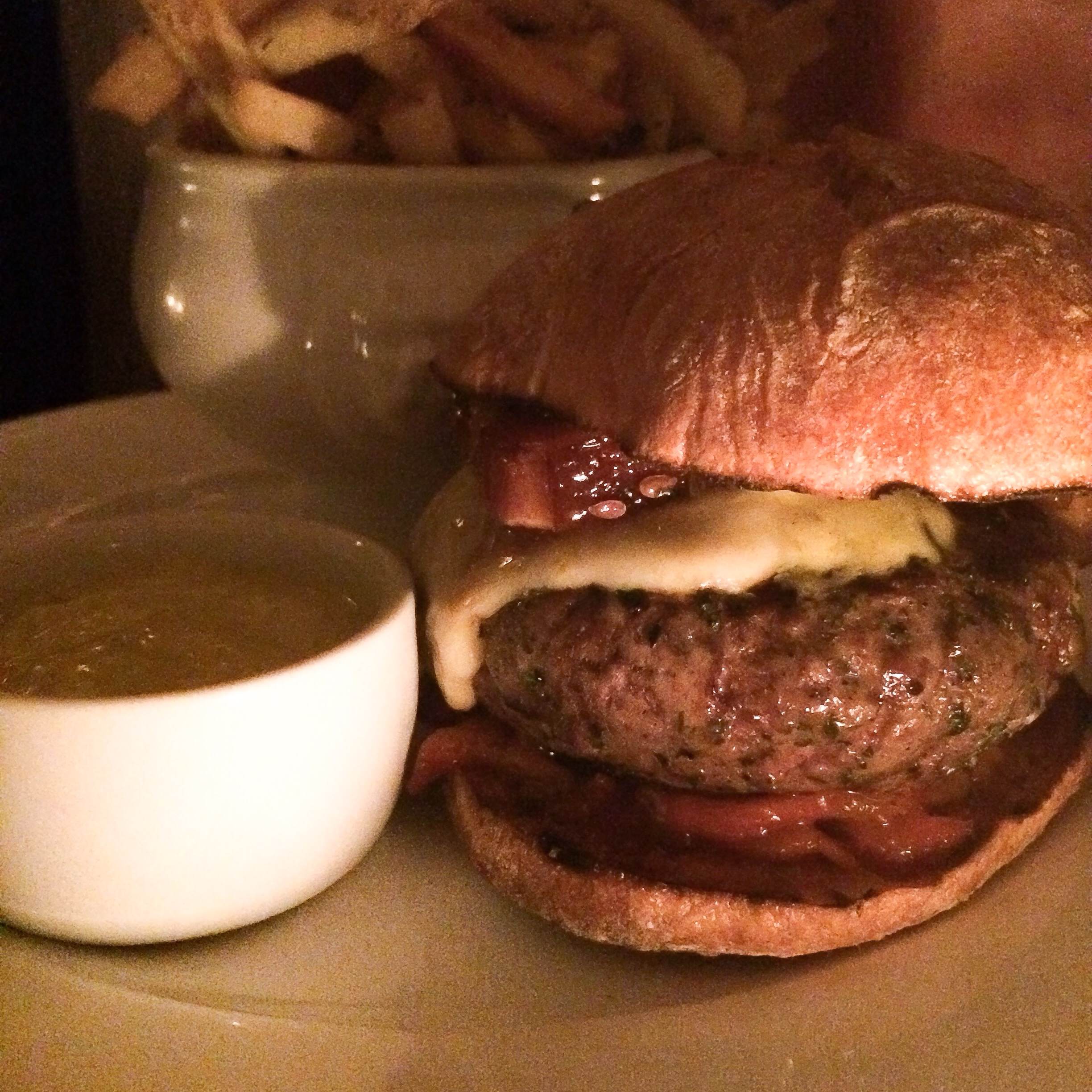
Cards on the table: The Fat Albert is completely gross. Just unbelievably disgusting. Cool? Cool.

It features the same (vaguely depressing, very middling) provolone-coated six-ounce patty found on the Dr. Joyce Brothers. But this time, the patty has ample backup in the flavor department. Two strips of applewood smoked bacon are splayed out parallel atop the cheese. The cheese and bacon are the only toppings. Then the fun starts: the Fat Albert offers a liberal swirl of maple syrup. This mounting arterial nightmare is served on a glazed doughnut.

If the patty was problematic on the Dr. Joyce Brothers, it was because there was nothing to compensate for its lack of flavor. Here, that wasn’t as much of a problem. The bacon was smoky, salty, and crisp, fried to a crackling brick red. At the risk of sounding like a greedy piece of shit, two strips wasn’t really enough; about halfway into the burger, I realized I wasn’t going to get bacon in every bite, and let me tell you: that was a sad moment for me.

The savory and salty patty-bacon combo played nice with the mild, sweet provolone. But that was about the only subtlety here. The maple syrup and the glazed doughnut offered a fearlessly aggressive sweetness that went to war with the savory stuff in every bite. The opaque, sugary glaze from the doughnut melted from the heat of the meat and oozed onto the patty, settling in the space between strips of still-sizzling bacon.

This burger was weird. It was counterintuitive. It was astonishingly unhealthy. And it was hard to put down. To be clear, it is not something I could eat every day (assuming arguendo that my heart could sustain that kind of rampant abuse, which – obviously – it could not). But I’m glad I ate it today.

It kind of felt like a Chicagoan’s idea of what the typical Los Angeles native is like: adventurous, loud, and extroverted, with an exterior that’s just sweet enough to compensate for the fact that it’s a little boring on the inside. There isn’t much (besides the sultry provolone lurking coyly between bacon and beef) to talk about beyond the stark and obvious contrast between sweet (doughnut/syrup) and savory (beef/bacon/cheese). There are precious few intricacies lurking behind the big, showy (and, sure, delicious) contradiction that comes at you right up front.

And you know what? That’s actually okay. This burger isn’t meant to be complex. It’s a culinary fart joke: crude, juvenile, and obvious to the point of unsophistication. But you can’t help but love it a little bit.

The Ratings
Dr. Joyce Brothers
Flavor: 4.30 / 10.00
Freshness/Quality: 6.00 / 10.00
Value: 7.00 / 10.00
Efficiency: 8.80 / 10.00
Creativity/Style: 4.20 / 10.00
Bun: 8.50 / 10.00
Patty: 7.20 / 10.00
Toppings: 5.00 / 10.00
Sauce: 5.10 / 10.00
Balance: 5.00 / 10.00

Total: 61.10 / 100.00

Fat Albert
Flavor: 8.80 / 10.00
Freshness/Quality: 6.20 / 10.00
Value: 8.20 / 10.00
Efficiency: 8.80 / 10.00
Creativity/Style: 9.80 / 10.00
Bun: 9.10 / 10.00
Patty: 7.20 / 10.00
Toppings: 7.90 / 10.00
Sauce: 8.60 / 10.00
Balance: 8.80 / 10.00

Total: 83.40 / 100.00
Cassell’s Hamburgers

IMG_3183Al Cassell founded Cassell’s back in 1948. The idea was a hamburger stand that stuck to the basics; the original menu consisted of nothing but burgers, a patty melt, and a couple sandwiches. Since reopening in Koreatown less than a year ago, Christian Page has expanded the menu a bit (now you can get breakfast, some pie, a house-made soda, or a cocktail). For the most part though, this place has stayed true to its founder’s vision: a focus on burgers and a commitment to quality.

I went with Greg and Lemi to check out the new, hipster-friendly, mod-diner iteration of Cassell’s on the ground floor of the Hotel Normandie, and see how this burger stacked up.

The Place
Cassell’s
3600 W. 6th Street
Los Angeles, CA 90020

The Order: Cheeseburger (Swiss Cheese, tomato, lettuce, pickle, red onion, nitrate free bacon, avocado, cooked medium rare (server recommendation)); Saint Archer IPA, Vanilla Coke (I was at a diner; how could I not?).

The Price: $13.49 (burger); $3.50 (Coke); $7.00 (IPA).

The Burger
Process matters at Cassell’s. So does tradition. That’s why they use the same grinder to grind the meat every day, the same press to make the patties, and the same crossfire broiler that Al Cassell himself used to fire up burgers all those decades ago.

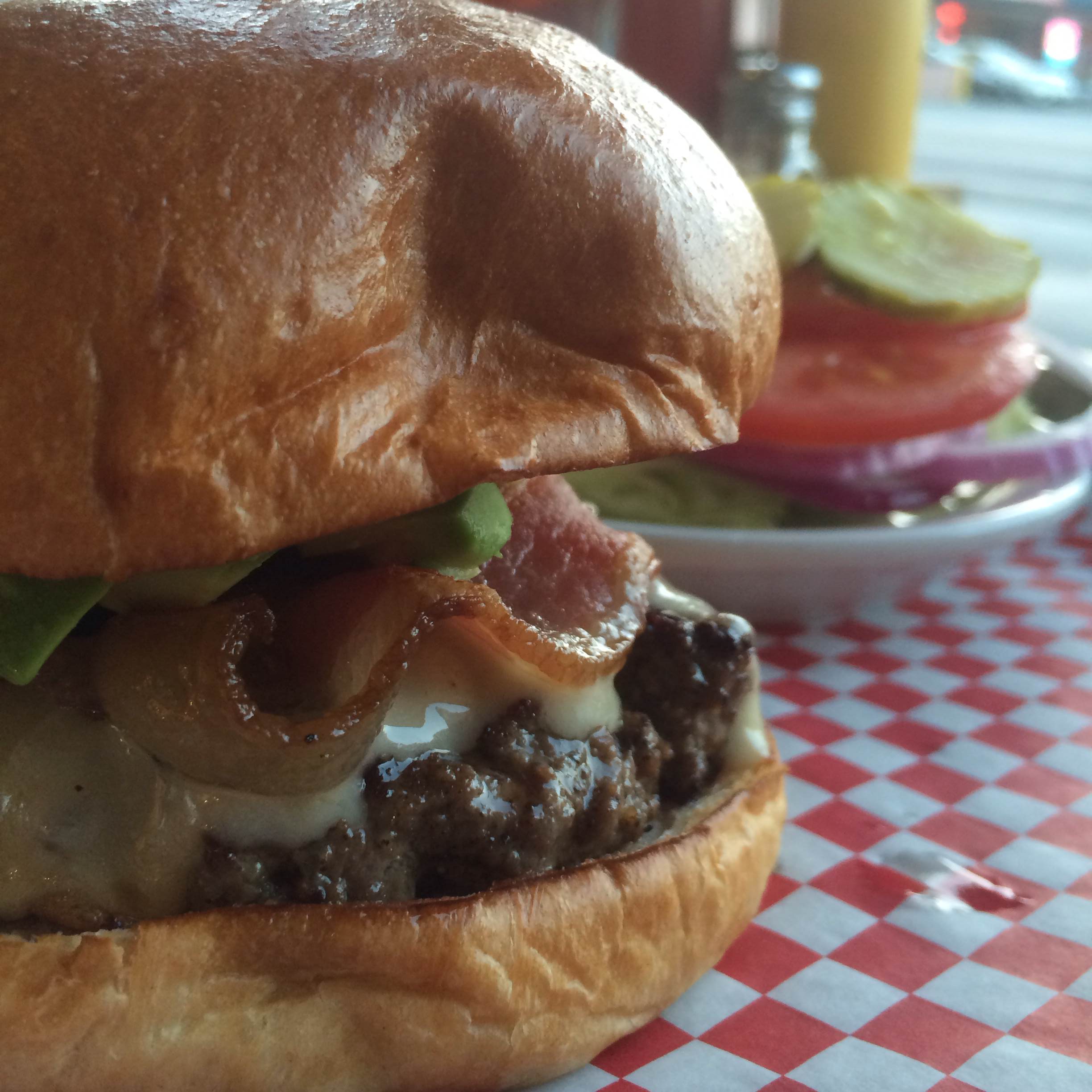
Besides that, the burger’s personality hasn’t really changed, even if it’s been updated for modern usage. This is, at bottom, a diner burger. The base model comes with nothing more than meat on a bun (with cheese, if you order it). Lettuce, tomato, pickles, onion, and Thousand Islands dressing are included on the side – add as much or as little as you want – and you can (for a fee) add nitrate-free bacon, avocado, a fried egg, or grilled onions. Mine came to me with avocado (because I’m Californian) and bacon (because I’m a human being). I added one (perfectly-sized) piece of lettuce, three pickle chips, one slice of tomato – deep red, firm and juicy – and three concentric rings of red onion, as well as a thin glaze of Thousand Island on the top bun.

There’s an important point to be made here. Cassell’s has some (not all) of the options (bacon, avocado, fried eggs) that have become standard fare at gourmet burger shops across the city. They are aware of and attentive – if perhaps a touch resistant – to the fact that people like to put lots of deviant shit on their burgers (deviant, that is, from the pre-Loving v. Virginia perspective of Al Cassell, so take it with a grain of salt). And sure, they’ll let you add the frills if you must (and I must), but those frills decidedly are not what they’re selling.

So what are they selling? Like I said, this is a diner burger. They’ve taken Al Cassell’s old formula and updated it in subtle ways. Some things haven’t changed – there’s only so much you can do to lettuce, tomato, pickles, and red onions. But there are other areas where things have changed, and it’s pretty evident that these are the things about which Cassell’s is proudest – specifically, the bun and the meat.

This bodes well. Practically, it means Cassell’s doesn’t depend on novel toppings to prop up an otherwise shitty burger. They don’t want you saying, “Wow, this patty tastes like cardboard and raw quinoa, but is that kimchee?” You might say these are burger purists. They focus on the components that matter. The Parker House buns were crisp on the outside, but milky and buttery on the inside, a rich complement to the crunchy, fresh garnishes, and a worthy counterpart to the bold, juicy patty. They are light but hardy. They stayed dry without being heavy, and they were firm without being tough.

As for the patty, it’s pretty obvious that this thing is Page’s baby. It’s a 1/3 pound suspension of Colorado Angus chuck and brisket that makes Shake Shack look like Burger King. It was flavorful and bold, with the different meats imparting subtle differences in flavor and tone. At medium rare, it was perfectly cooked: delicately charred on the outside, with enough juicy personality inside to keep things interesting without making a mess.

A couple things stick out when you eat this burger. First, everything on it is absurdly fresh. The meat tastes like it was ground today. The lettuce is crisp and cool. The tomatoes are explosively juicy. Even the onions, had a sassy, crunchy tang. The pickles, sadly, got a little lost in the shuffle. They weren’t particularly sharp or sour, and as a result, ended up tasting more like cucumber on which someone had spilled vinegar. The Thousand Islands was similarly unexceptional. This may have had something to do with the fact that I didn’t add enough, but I tasted a bit off the blade of my knife, and it was insipid even outside the context of the burger.

The optional toppings were excellent. The cheese was a thin slice of Swiss that delicately melted over the patty. It added depth of flavor without being intrusive or sharp on the palate, and it had maintained enough solidity that it wasn’t stringy or stretchy. The bacon was thick cut and crisp, exactly how burger bacon should be. The avocado was generously portioned and perfectly ripe – which means it was firm, not flabby, smeary quasi-guacamole.

The interplay between bacon and avocado was, predictably, wonderful, especially since the former was perfectly prepared. The other garnishes were fresh and crisp enough to impart some actual gustatory interest, rather than just being “those things that are not meat and also slightly less hot than everything else.” The freshness of all the ingredients allowed their respective tastes to shine through, which gave the burger’s flavor profile layers, which revealed themselves in every bite. Presenting the garnishes on the side means you have total control over how dominant any one flavor will be – a pleasant intermissio from the presumptuous, peri-fascist paternalism of other burger places.

On the whole, the flavors in this burger balance well, but that’s to be expected when you employ such a tried and true formula. It’s hard to credit Cassell’s with executing a precarious balancing act with aplomb. They didn’t do that at all. Instead (and by design, mind you), they did a simple thing well. Rather than trying to buck convention, they embrace it. This is a unapologetically classic American hamburger. It is the kind of thing you would buy your tourist friends when they ask to eat American food.

Having said all that, here’s my gripe. I said before that these are burger purists. Maybe that’s true. The other possibility is that they’re a little risk-averse. I couldn’t shake the feeling that this place is holding something back. The quality of the preparation led me to wonder if maybe the whole “mom-and-pop” schtick isn’t really just a cop-out, an excuse to not get creative and take risks. Because some decidedly modern culinary flourishes (most notably the patty) notwithstanding, this burger is a period piece. There is untapped creativity here. Page clearly is talented and inventive, but his burger, though very good, felt as though it was as unchallenging for him to conceive and execute as it was for me to eat and enjoy.

Now, part of me appreciates that. In a scene where everyone seems to be trying to do something shocking, it’s refreshing to eat a burger that’s just concerned with doing things right. But still, I feel like Page is capable of more that “just” a great diner burger. And as unfair as it may be, I think he could make a burger that is truly something special. This isn’t it. All this one is is really damn good. Which I guess I’m willing to settle for.

The Ratings
Flavor: 9.10 / 10.00
Freshness/Quality: 9.50 / 10.00
Value: 7.40 / 10.00
Efficiency: 9.40 / 10.00
Creativity/Style: 6.70 / 10.00
Bun: 9.00 / 10.00
Patty: 9.40 / 10.00
Toppings: 8.70 / 10.00
Sauce: 7.20 / 10.00
Balance: 8.40 / 10.00

Total: 84.80 / 100.00

The Tasting Kitchen

IMG_3169The Tasting Kitchen is a Venice mainstay. It’s grown up from its humble beginnings of handwritten menus and a perennially exhausted but always good-natured staff. It bears mentioning at the outset that while a lot of things have changed (for the better, I might add) about Casey Lane’s shop, the service remains absolutely top-notch. Our experience was pretty fantastic (except for an awkward incident with a waiter getting a little snappy with a busboy within earshot of our table).

ANYWAY. The Tasting Kitchen probably is best-known (aptly) for its tasting menu, but its burger has been a quiet staple on the menu for a while now, and I felt compelled to investigate. Rob and I went there on a bro-date, and when we weren’t too busy falling embarrassingly in love with one of the servers there, we ate the burger.

The Place
The Tasting Kitchen
1633 Abbot Kinney Boulevard
Venice, CA 90291

The Order: BCC Burger (braised bacon, chile chutney, cheddar), French Fries, Japanese Goldrush (Nikka Malt, lemon, honey).

The Price: $17 for the burger and fries. $16 for the cocktail.

The Burger
The Tasting Kitchen’s bill of fare features a diverse array of dishes, running the gamut from traditional (they do a pretty straightforward, slow-hot bucatini all’amatriciana) to more adventurous (grill-charred octopus with earthy Roman beans and brash ‘nduja). Their burger would probably best be characterized as non-traditional. It eschews the conventional toppings in favor of a more minimal approach, but each topping seems to be tailored to bring maximal flavor. Besides the cheese and the (substantial) patty, there are only two things between the rustic buns: a thick, all-business slab of braised bacon and a roasted chile chutney. An unobtrusive aioli was served on the side.

After a little bit of a wait to get things started, there wasn’t much time between courses. The burger came out just after our appetizers had settled. The meat was of obvious quality, and was well-prepped for cooking. The patty was thick and juicy. My main complaint is similar to the one I expressed about the patty on the griddled cheeseburger at Ledlow: it was way undercooked. The meat was essentially rare, and with a patty of that size, two problems result. First, the bottom bun got soaked through – especially since it was much thinner than its counterpart on top. Second, being so undercooked, the meat didn’t cohere well, and the patty kind of fell apart on us while we ate. It tasted good enough, but it wasn’t easy to eat.

The chile chutney was a brave addition, and was given serious prominence. It was smoky and rich, but without a lot of other flavors to complement it, it sort of stuck out. Out there on its own, with nothing to blunt its fierce roasted boldness, it was sort of a lonely renegade on the burger’s flavor profile. The braised bacon, however, was a masterstroke. It was a thick slab of pig, salty and rich, but gorgeously marbled and decadent. It didn’t blend particularly well with the chiles, unfortunately. Had the chutney been a little sweeter (like one customarily would expect chutney to be), it would have played beautifully off the flavor of the bacon. As it was, the burger featured two toppings – one fine, one fabulous – that didn’t quite mesh together. Adding the aioli didn’t achieve much. It cut the richness of the bacon a bit, and didn’t blend particularly well with the chutney. Frankly, the sauce didn’t seem tailor-made for the burger. It went better with the French fries (which, for the record, were stellar).

The bun was great. It evoked a sourdough, being far less eggy than a brioche. The bottom bun was a little thin, which drew extra attention to the fact that the patty was undercooked. Saturated with juices and blood from the beef, it quickly got soggy and flimsy, like wet paper, and lost a lot of its delightful texture. It was a shame, because it was, on its own, quite a wonderfully-crafted bun.

Much like the restaurant itself, the burger featured a wide variety of flavors coexisting side-by-side. That’s cool, but it’s also kind of the problem with the dish. The ingredients didn’t come together in such a way that the whole was greater than the sum of its parts. The BCC burger presents a few different textures and tastes, but the union doesn’t feel necessary or inevitable. It’s far from conventional, but that alone didn’t make it unforgettable.

The Ratings
Flavor: 7.80 / 10.00
Freshness/Quality: 8.90 / 10.00
Value: 6.00 / 10.00
Efficiency: 8.50 / 10.00
Creativity/Style: 9.00 / 10.00
Bun: 8.90 / 10.00
Patty: 7.90 / 10.00
Toppings: 8.40 / 10.00
Sauce: 7.50 / 10.00
Balance: 7.90 / 10.00

Total: 80.80 / 100.00

Ledlow

Displaying IMG_3154.JPGJosef Centeno rightly has become kind of a local celebrity in Downtown Los Angeles. Over the past few years, he has been opening new restaurants at a furious pace, and has established himself as the preeminent culinary personality in the neighborhood. Between Main and Los Angeles, 4th Street essentially belongs to him. The fantastic young trio of Bäco Mercat, Bar Amá, and Orsa & Winston is deservedly beloved by critic and consumer alike – GQ’s Alan Richman hailed Bäco Mercat as the ninth-best restaurant in America in 2013.

Ledlow is the newest addition to the group. It offers American small-plate fare that emphasizes simplicity, preparation, and ingredient quality. They offer gently modernized iterations of familiar dishes – their deviled eggs and Tasso ham is among their most popular dishes; it takes the workhorse ham and eggs and softens the edges with tarragon and cornichon. THis place has already generated enormous buzz – including a coveted review from Jonathan Gold, and it’s easy to see why. The small plates are simple, fresh, beautifully prepared, balanced, flavorful, and just complex enough to be interesting without getting too zany.

The cheeseburger is one of the most popular items on the menu. My companion Shannon and I put it to the test.

The Place
Ledlow
400 South Main Street
Los Angeles, CA 90013

The Order: Griddled Cheeseburger and Fries (single), Rye Smile (rye, lemon, maraschino, ginger, soda)

The Price: $14 (excluding tax) for the burger, $12 (excluding tax) for the cocktail.

The Burger
The burger is pretty consistent with Ledlow’s governing philosophy. Rather than challenging the eater by piling on surprising ingredients, Ledlow’s attempts to offer the most sophisticated version of a classic dish. As such, the changes to the traditional diner cheeseburger are, at least nominally, minimal. In a quietly irreverent move, a poppy seed bun replaces the traditional sesame seed bun. Cheddar and American cheeses are melted together on the patty. A Dijon and garlic aioli is the lone condiment. Besides that, only lettuce, pickle, and red onions accompany one four-ounce patty (for an extra $2, diners can get an extra four-ounce patty; an extra $4 will get you a triple).

Sadly, Ledlow’s offering is much better in theory than in practice. While the conception is just fine, the execution was sloppy. When the burger finally did come out (and it took some time), we were disappointed to find the ingredients were unbalanced and the burger did not hang together well. A single, fiercely curling (and maddeningly isosceles) triangle of lettuce was almost exclusively on one side of the burger. Though crisp and fresh, it was too present on one half of the burger, and barely there on the other.

Ledlow’s menu expressly says they prepare their burgers “cooked through.” This begs the question of what constitutes “rare” there, considering our burger was red – not pink – on the inside. While there certainly is nothing wrong with rare meat in general, beef as rare as this is difficult to justify in a burger. The bun was also problematic: it was dry and grainy in the middle, and soggy where it met the contents of the burger.

This burger’s fatal flaw, however, was balance. The assembly of the burger highlighted all of its flaws. The ingredients all fought to get to the front of the flavor profile rather than complementing one another. In the end, the onions and the aioli won out (to the detriment of the burger). They completely dominated the burger; every bite was totally overrun by the sharpness of the onions and Dijon on the front-end, which gave way to a garlicky finish.

Sadly, this really ended up masking some of the burger’s virtues. For instance, even though the golden alloy of cheeses was a subtle touch that really actually did add some complexity and dimension, it was essentially impossible to taste in the midst of the nuclear winter of aioli and onion. Moreover, we couldn’t discern how (or even if) the patty was seasoned (the fact that it was way undercooked likely didn’t help, since the overabundance of juices masked whatever gasping residue of seasoning survived the gustatory onslaught of the onions and sauce).

There are a couple of potential fixes here (I’m not sure how accommodating the restaurant would be of requests like these or how effective they might be, but it certainly is worth a shot). Most obvious would be to order the aioli on the side, and remove a few of the onions prior to diving in. Next, ask for your burger to be cooked medium to medium-well. If they tell you the burger will be cooked through, ask them to go a even shade further on the well-done end than they normally would. Finally, the burger comes with a little tub of ketchup for the French fries (which, parenthetically, were delicious). Add a little. The burger’s flavor profile would have benefited a lot from the sweetness that ketchup imparts. It might have blunted the harsh front-end flavors that made the burger tough to enjoy.

I would be remiss if I didn’t say that the other food Shannon and I had while at Ledlow was delicious. Creamy deviled eggs wedded beautifully with indulgent strips of leathery Tasso ham and misty tarragon, all anchored by perfectly proportioned potatoes, which added just enough starch to keep the dish grounded. It was easy to see why this is another of Ledlow’s signature dishes. Their vegetable crudités also looked stunning, a long piece of wood bearing various and sundry fruits and vegetables – some raw and some sumptuously grill-blackened. The dishes here are brave for their simplicity. It is all about preparation and quality here. When Ledlow hits, it hits hard and memorably. Unfortunately, the burger was simply disappointing.

The Ratings
Flavor: 6.50 / 10.00
Freshness/Quality: 8.10 / 10.00
Value: 6.00 / 10.00
Efficiency: 4.50 / 10.00
Creativity/Style: 6.40 / 10.00
Bun: 6.50 / 10.00
Patty: 7.70 / 10.00
Toppings: 7.70 / 10.00
Sauce: 5.60 / 10.00
Balance: 5.00 / 10.00

Total: 64.00 / 100.00

In-N-Out Burger

Displaying IMG_3137.JPGIf we’re being honest with ourselves, this saga could only have started here. Since taking Baldwin Park by storm in 1948, In-N-Out has become a staple of life in California. Over the years, it has achieved nationwide fame, even being the subject of an extended, gushing soliloquy by a starstruck Anthony Bourdain. In-N-Out Burger is what most people in Los Angeles think of when they hear the word hamburger. The Los Angeles burger scene started at In-N-Out Burger. It is only fitting, then, that the Los Angeles Burger Project starts there as well.

The Place:
In-N-Out Burger
310 N. Harvey Drive
Glendale, CA 91206

The Order (pictured above): Double-Double (mustard fried, no tomato, onions, extra toast on the bun); French fries, Coke.

Price: $7.41 (including tax).

The Burger
What can I write that most of you don’t already know? In-N-Out has mastered the art of the burger, and executes fresh (never frozen), impossibly consistent masterpieces thousands of times daily. The strength of this burger is in its simplicity. The cheese is melted and gooey without being messy. Wonderfully fresh and crisp lettuce and onions give the burger textural complexity. The lettuce is especially praiseworthy: never wilted, in spite of its proximity to freshly-grilled meat and melted cheese. The spread is tangy without being overpowering.

You could make a pretty strong case that the bun is the strongest element of the burger. Perfectly sized, perfectly absorbent, perfectly toasted, this bun has just enough independent flavor to influence the taste profile of the burger without dominating it. While many gourmet burgers feature a buttery brioche, In-N-Out’s bun is more traditional, but perfectly suited to the fresh simplicity of the offering.

Ultimately though, the meat is the marquee feature. The immaculately seasoned patties are juicy and perfectly cooked – just far enough past medium rare to preserve the meat’s natural flavor and juiciness, while also avoiding being messy or bloody (though, if you prefer a bit more blood and a bit less structure, you are free to request that the meat be medium rare). Notes of crackling fried mustard lingers under the delicate char. The thin patties provide a greater seasoned surface area, which gives the meat much more depth of flavor than a brutish, thick patty might.

In-N-Out is perhaps most impressive, though, for its consistency. This is a restaurant that has never compromised on its core values of making fresh, delicious food. Their commitment is evident in their consistently delicious and perfectly prepared burgers. Pull up to an In-N-Out Burger in the middle of nowhere, and you can be damn certain that you will get the same phenomenal product you would get from them in the heart of Los Angeles.

In-N-Out is not the place to go if you are looking for an inventive, boundary-pushing burger. Their menu is small, their ingredients limited, and their focus narrow. They make no effort to reinvent the wheel. They have a winning formula, and they stick to it. The food here will not challenge you. It will not surprise you. But it is also much more than just a known quantity. In-N-Out never wanted to redefine the burger. They just wanted to master it. And that, they have achieved in spades.

The Ratings
Flavor: 9.70 / 10.00
Freshness/Quality: 9.80 / 10.00
Value: 10.00 / 10.00
Efficiency: 10.00 / 10.00
Creativity/Style: 7.50 / 10.00
Bun: 9.70 / 10.00
Patty: 9.50 / 10.00
Toppings: 8.90 / 10.00
Sauce: 8.80 / 10.00
Balance: 9.10 / 10.00

Total: 93.00 / 100.00